← मुखपृष्ठ3 मिनट का पाठ
विशेष लेख
10 Must-Know Facts About Elephants
These herbivores consume various vegetation including grasses, leaves, fruits, and roots, adapting their diet to seasonal availability. During arid periods, they increasingly consume woody vegetation like branches and bark. Their daily consumption reaches 150 kilograms of plant material, though nearly half passes through undigested. This substantial dietary requirement occupies up to 18 hours of their daily routine.
T
Thomas Moore
लेखक
लेख परिचय
नीचे पूरा लेख पढ़ें।
अनुभाग
समाचार
Unrivaled in Scale
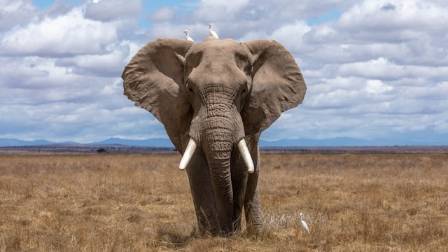
The African Savanna Elephant holds the title of Earth's largest terrestrial creature. Mature males typically reach heights of 3 meters and weigh an astonishing 6,000 kilograms. These magnificent bulls achieve their full dimensions between 35-40 years of age, representing more than half their natural lifespan of 60-70 years. Even newborns demonstrate remarkable size, with calves entering the world at approximately 120 kilograms.
Distinguishing Physical Features
Three elephant species exist: African Savanna, African Forest, and Asian elephants. African elephants possess notably larger ears that mirror the continent's outline, while their Asian counterparts display ears resembling the Indian subcontinent's shape. Another key distinction lies in their trunk anatomy - African species feature two finger-like projections at the trunk's tip, whereas Asian elephants have only one.
The Remarkable Trunk
An elephant's trunk represents an extraordinary biological marvel, containing approximately 150,000 individual muscle units, making it among the most sensitive mammalian organs. This versatile appendage functions as both a drinking tool, capable of holding 8 liters of water, and as a natural snorkel during aquatic activities.
Tusks and Their Dual Nature
Elephant tusks are essentially elongated incisor teeth that emerge around age two, growing continuously throughout their lives. These impressive structures serve multiple purposes: extracting tree bark, unearthing roots, and providing defensive weapons. Tragically, their ivory composition makes them targets for poaching, creating significant threats to elephant populations.
Specialized Skin Characteristics
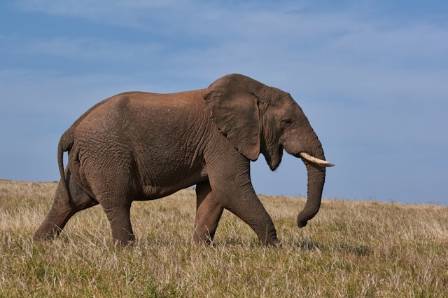
An elephant's skin measures about 2.5 centimeters thick across most body areas. The intricate network of folds and creases can retain ten times more moisture than smooth skin, providing essential cooling benefits. Regular dust and mud bathing sessions help maintain skin hygiene and offer protection against solar damage.
Constant Nutritional Needs
These herbivores consume various vegetation including grasses, leaves, fruits, and roots, adapting their diet to seasonal availability. During arid periods, they increasingly consume woody vegetation like branches and bark. Their daily consumption reaches 150 kilograms of plant material, though nearly half passes through undigested. This substantial dietary requirement occupies up to 18 hours of their daily routine.
Sophisticated Communication
Elephants employ diverse communication methods including audible calls (some below human hearing range), physical gestures, tactile contact, and scent signals. They also transmit and detect seismic vibrations through the ground, potentially sensing these signals through bone conduction.
Rapid Calf Development
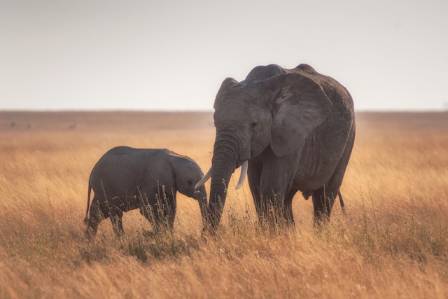
Newborn elephants demonstrate incredible adaptability, standing within 20 minutes of birth and walking within one hour. Within two days, they can maintain pace with their traveling herd. This accelerated development ensures migratory groups can continue seeking essential resources without extended delays.
Exceptional Memory Capacity
Elephants possess a temporal lobe - the brain region associated with memory formation - that exceeds human counterparts in both size and density, providing biological basis for their legendary recall abilities.
Conservation Challenges
The past century has witnessed a devastating 90% reduction in African elephant populations, primarily driven by ivory exploitation, with only about 415,000 individuals remaining wild. Asian elephants face similar crises, experiencing at least 50% population decline over three generations, with merely 48,000-52,000 surviving in natural habitats. Habitat fragmentation and conversion to human settlements increasingly obstruct traditional migration corridors, forcing dangerous interactions between elephants and human communities while limiting access to vital resources.
यह भी पढ़ें

en
Mastering the 4 Key Types of Basketball Defense
Henry Blackwood

hi
रंगीन घर की सजावट के लिए गाइड: इंटीरियर में रंगों का उपयोग कैसे करें?
निशा

en
Exploring the Milky Way
Hazel Grant

en
Cheesy Vegetable Medley
Elijah Moore

hi
नारियल और हथेलियाँ: थाई जीवन का एक अभिन्न अंग
अर्जुन

en
Swiss Roll Facts for Kids: The Delicious Spiral Cake Sensation
Daniel Young