विशेष लेख
Osaka Castle: A Journey Through Four Centuries of Japan’s Turbulent Past
Osaka Castle stands as an enduring icon of Japan’s feudal heritage, its walls and towers bearing witness to over 400 years of conflict, reconstruction, and cultural transformation. Commissioned in 1583 by the legendary warlord Toyotomi Hideyoshi, this grand fortress has weathered sieges, fires, and the winds of modernization, yet remains a powerful symbol of Japan’s resilience and historical depth. From its origins as a monument to unification to its current role as a cherished cultural hub, Osaka Castle’s story is deeply intertwined with Japan’s evolution into the nation it is today. Let’s explore the rich and complex history of this remarkable structure.
Oliver Bennett
लेखक
लेख परिचय
नीचे पूरा लेख पढ़ें।
अनुभाग
समाचार
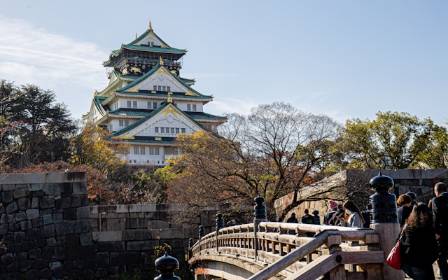
Osaka Castle stands as an enduring icon of Japan’s feudal heritage, its walls and towers bearing witness to over 400 years of conflict, reconstruction, and cultural transformation. Commissioned in 1583 by the legendary warlord Toyotomi Hideyoshi, this grand fortress has weathered sieges, fires, and the winds of modernization, yet remains a powerful symbol of Japan’s resilience and historical depth. From its origins as a monument to unification to its current role as a cherished cultural hub, Osaka Castle’s story is deeply intertwined with Japan’s evolution into the nation it is today. Let’s explore the rich and complex history of this remarkable structure.
Origins and construction under Toyotomi Hideyoshi
The tale of Osaka Castle begins with Toyotomi Hideyoshi, a figure whose rise from humble peasant roots to Japan’s de facto ruler is one of the most dramatic in the nation’s history. Determined to create a fortress that would both showcase his authority and serve as an impenetrable military stronghold, Hideyoshi chose the site of the former Ishiyama Hongan-ji temple which destroyed by his predecessor, Oda Nobunaga, as the foundation for his vision.
Hideyoshi’s plans for Osaka Castle were nothing short of monumental, aiming to surpass even Nobunaga’s renowned Azuchi Castle in size and splendor. The main tower, or tenshu, stood five stories high from the outside but contained eight internal levels, a design that combined grandeur with practicality. No expense was spared in its decoration: the exterior was adorned with gold leaf and intricate carvings, intended to awe visitors and deter potential enemies.
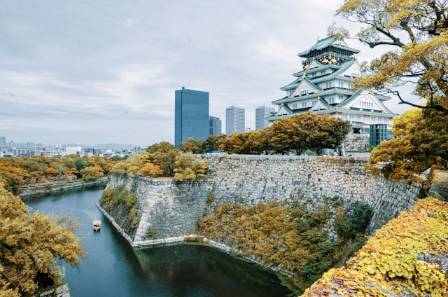
The castle’s defensive features were equally impressive. Encircling the complex were massive stone walls, some reaching up to 20 meters in height, constructed using a technique known as “burdock piling.” This method involved fitting together enormous granite boulders without mortar, creating a structure of remarkable strength. Many of these stones were transported from quarries near the Seto Inland Sea, each bearing the family crests of the daimyo (feudal lords) who contributed to the project.
By 1585, the inner keep was complete, but Hideyoshi continued to expand and strengthen the castle over the next decade. It was finally finished in 1597, a testament to his ambition and power. Tragically, Hideyoshi would not enjoy his creation for long; he passed away in 1598, leaving the castle to his young son, Toyotomi Hideyori.
The Siege of Osaka and fall of the Toyotomi clan
After Hideyoshi’s death, Osaka Castle became a focal point of tension between the Toyotomi clan and Tokugawa Ieyasu, one of Hideyoshi’s most powerful vassals, who sought to consolidate his own control over Japan. These tensions erupted into open conflict, culminating in the Siege of Osaka (1614–1615), a pivotal event that would shape Japan’s future.
The siege unfolded in two phases: the Winter Campaign of 1614 and the Summer Campaign of 1615. During the winter, Osaka Castle’s defenses proved formidable. Its thick stone walls and deep moats successfully repelled Tokugawa attacks, with Toyotomi forces which led by the brilliant strategist Sanada Yukimura holding off a numerically superior army.
The summer of 1615, however, brought disaster for the Toyotomi. Tokugawa forces breached the castle’s outer defenses, leading to a series of brutal battles around Osaka. The decisive Battle of Tennōji resulted in the complete defeat of the Toyotomi army. With the castle on the verge of capture, Hideyori and his mother, Yodo-dono, took their own lives. Osaka Castle was then set ablaze, marking the end of the Toyotomi legacy and securing Tokugawa rule over Japan.
Reconstruction and expansion by the Tokugawa shogunate
In 1620, Tokugawa Ieyasu ordered the reconstruction of Osaka Castle, seeking to erase the remnants of Toyotomi power and establish his own authority over the region. The project was overseen by Tōdō Takatora, a master castle architect, under the direction of Tokugawa Hidetada, Ieyasu’s son and successor as shogun.
The Tokugawa-era castle retained the original site but featured significant redesigns. The stone walls were made taller and thicker, the moats deepened, and the main tower rebuilt as a five-story structure even more imposing than Hideyoshi’s original. The interior was also reconfigured to serve the administrative needs of the Tokugawa shogunate, reflecting its new role as a center of governance rather than a symbol of a single warlord’s power.
This reconstruction served multiple purposes: it demonstrated the Tokugawa’s dominance over the former Toyotomi stronghold, provided a strategic defensive position in western Japan, and housed a large garrison of samurai tasked with maintaining control over the region.
Tragedy struck again in 1665, when the main tower was hit by lightning and burned to the ground. Though other parts of the castle complex remained intact, the iconic tenshu was not rebuilt, leaving Osaka Castle without its most recognizable feature for centuries.
Decline and destruction during the Meiji Restoration
The Meiji Restoration of 1868 marked a dramatic shift in Japan’s history, as the country began to modernize and dismantle its feudal system. For Osaka Castle, this era brought significant changes in its role and fortune. As feudalism faded, many castles across Japan were abandoned or destroyed, seen as relics of a bygone era.
During the Boshin War (1868–1869), which ended Tokugawa rule, Osaka Castle was briefly occupied by imperial loyalist forces. In the war’s aftermath, much of the complex was repurposed or left to decay. The new Meiji government, focused on industrialization and modernization, saw little value in preserving feudal fortresses and began to convert parts of the castle grounds for military use.
Over the following decades, the site became a major army arsenal, producing weapons and ammunition to support Japan’s expanding imperial ambitions. While this adaptation saved some structures from demolition, it also exposed the castle to new risks. During World War II, the arsenal became a prime target for Allied bombing raids, resulting in significant damage to the complex. By the end of the war, much of Osaka Castle lay in ruins, a shadow of its former grandeur.
Modern reconstruction and current state
In the post-war period, Japan experienced a renewed interest in preserving its cultural heritage, and Osaka Castle became a key focus of these efforts. In 1931, the main tower was reconstructed using modern materials, including concrete, based on historical photographs and drawings of the Tokugawa-era keep. This marked the first step in restoring the castle’s iconic silhouette to Osaka’s skyline.
A more extensive restoration project took place in 1995–1997, aiming to bring the castle closer to its Edo-period appearance. The exterior of the main tower was refurbished to better reflect its historical design, while the interior was transformed into a museum dedicated to the castle’s history and the life of Toyotomi Hideyoshi.
Today, Osaka Castle is one of Japan’s most popular tourist destinations, drawing millions of visitors annually. The castle grounds have been converted into a public park, offering a peaceful oasis in the heart of bustling Osaka. The park is particularly famous for its cherry blossoms in spring, when thousands gather to enjoy hanami (cherry blossom viewing). Though the current structure is a modern reconstruction, it serves as a vital link to Japan’s past, embodying Osaka’s enduring spirit.
Architectural features and layout of Osaka Castle
Osaka Castle’s design represents the pinnacle of Japanese castle architecture during the late 16th and early 17th centuries. The complex is built on two raised platforms of landfill, supported by steep walls of cut stone assembled using the burdock piling technique. These walls, some of the most impressive in Japan, reach heights of up to 20 meters and remain a testament to the engineering skill of the period.
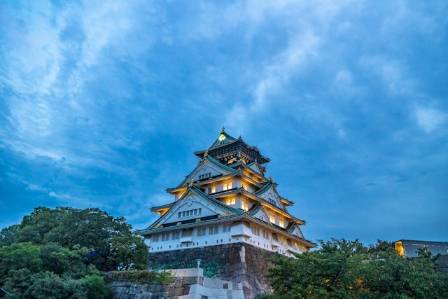
The main keep is the castle’s centerpiece. Externally, it stands five stories tall, but internally, it contains eight levels, a design that maximizes space and functionality. The modern reconstruction faithfully replicates the Edo-period exterior, with white plastered walls, dark wooden accents, and gold-leafed decorations, including the famous shachi (mythical tiger-fish) ornaments that adorn the roof, symbolizing protection from fire.
Surrounding the main tower are a range of defensive structures, including:
The Ote-mon Gate, the grand entrance to the castle complex
Several yagura (watchtowers) positioned strategically along the walls
The Kinzo and Enshogura, historic storehouses
Multiple baileys (maru), concentric defensive rings that provided layered protection
The castle grounds also include the Nishinomaru Garden, a stunning landscape garden that offers panoramic views of the main tower. With its meticulously maintained lawns, ponds, and flowering trees, the garden enhances the castle’s beauty and provides a tranquil space for visitors to relax.
Cultural significance and tourism at Osaka Castle
Osaka Castle holds a special place in Japanese culture, symbolizing not only the architectural brilliance of the feudal era but also the nation’s journey from a divided land to a unified state. Its history is closely linked to pivotal figures like Oda Nobunaga, Toyotomi Hideyoshi, and Tokugawa Ieyasu, making it a crucial site for understanding Japan’s transition from the chaotic Warring States period to the stability of the Edo era.
As a tourist attraction, the castle offers visitors a wealth of experiences. The on-site museum features exhibits on the castle’s history, including armor, weapons, and historical documents, while interactive displays and video presentations bring the past to life. The castle grounds host numerous events throughout the year, such as the Osaka Castle 3D Mapping Super Illumination, music festivals, and historical reenactments, allowing visitors to engage with history in dynamic ways.
Conclusion
Osaka Castle is more than a historic landmark; it is a living testament to Japan’s resilience, innovation, and rich cultural heritage. From its construction under Toyotomi Hideyoshi to its destruction and reconstruction over the centuries, it has mirrored the nation’s own journey through war, peace, and modernization. Today, as it stands against the backdrop of Osaka’s modern skyline, the castle bridges the gap between Japan’s feudal past and its vibrant present, inviting visitors to explore the stories, struggles, and triumphs that have shaped this remarkable nation. Whether admiring its grand architecture, wandering its cherry blossom-lined grounds, or delving into its history at the museum, a visit to Osaka Castle is a journey through time—one that reveals the enduring spirit of Japan.
यह भी पढ़ें

Japan’s 6 Signature Crab Varieties: Origins, Seasons, and How to Serve Them
Stella Ellis

झानकियाओ पियर – किंगदाओ ओल्ड टाउन
दिव्या

6 Things to Consider to Choose the Perfect Two-Seater Sofa for Small Spaces
Norma

रात में चौदहवाँ पहाड़ चढ़ना
विकास
8 Mind-Blowing Facts About the Squirrel Monkeys in the Jungle
Emma Jones

हेजहॉग के बारे में शीर्ष 10 तथ्य
यश