विशेष लेख
The Andromeda Galaxy: All you need to know
While dozens of smaller galaxies orbit closer to our own, the Andromeda Galaxy remains the nearest major spiral galaxy to the Milky Way. Aside from the Large and Small Magellanic Clouds—which are visible mainly from the Southern Hemisphere—Andromeda is the brightest galaxy beyond our own that can be seen in the night sky. Located approximately 2.5 million light-years away, it is also the farthest object visible to the naked eye under dark-sky conditions.
Aaron Blake
लेखक
लेख परिचय
नीचे पूरा लेख पढ़ें।
अनुभाग
समाचार
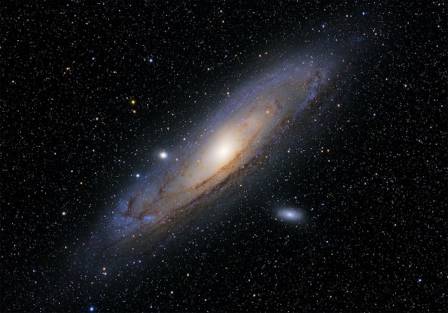
While dozens of smaller galaxies orbit closer to our own, the Andromeda Galaxy remains the nearest major spiral galaxy to the Milky Way. Aside from the Large and Small Magellanic Clouds—which are visible mainly from the Southern Hemisphere—Andromeda is the brightest galaxy beyond our own that can be seen in the night sky. Located approximately 2.5 million light-years away, it is also the farthest object visible to the naked eye under dark-sky conditions.
It’s worth noting that the Triangulum Galaxy lies not far behind at roughly 2.7 million light-years away. Like Andromeda, it belongs to the Local Group of galaxies and can sometimes be seen without optical aid. However, because it faces us almost directly and spreads its light across a larger area, it appears dimmer and is generally more difficult to spot.
A Neighbor in the Local Group
Astronomers often refer to the Andromeda Galaxy as Messier 31, or simply M31. It was the 31st entry in the famous catalog compiled by French astronomer Charles Messier during the 18th century. Messier created this list to help comet hunters avoid confusing permanent fuzzy objects with newly discovered comets.
Most objects in the Messier Catalog are star clusters or glowing nebulae within the Milky Way. Andromeda is different—it is an entire galaxy of its own and is even larger than our home galaxy. Under a dark sky, M31 appears as a faint elongated glow that spans a larger area than the full moon.
Best Times to Observe Andromeda
For observers in the Northern Hemisphere, Andromeda is visible during some part of the night throughout the year. However, it becomes especially convenient to view during late summer and autumn.
By August and September, the galaxy rises high enough to be seen from evening until dawn.
Early September: Look for it during mid-evening between sunset and midnight.
Late September and early October: It appears in the eastern sky at dusk, reaches its highest point around midnight, and remains visible toward the west before sunrise.
Winter evenings: Conditions are also excellent for viewing.
If you're away from city lights on a moonless night, you may notice Andromeda without any special effort. It often appears as a faint, hazy patch suspended among the stars.
Finding M31 Using the Great Square of Pegasus
One of the easiest methods for locating Andromeda involves using the Great Square of Pegasus.
During autumn evenings, the Great Square stands prominently in the eastern sky. Starting from one corner of the square, imagine a line extending through two stars that lead into the constellation Andromeda. Follow the chain of stars until you locate Mirach and Mu Andromedae.
By extending a line from Mirach through Mu Andromedae roughly twice the distance between those stars, you'll arrive at the Andromeda Galaxy. To the unaided eye, it appears as a soft patch of diffuse light.
Using Cassiopeia as a Guide
Another useful landmark is Cassiopeia, recognizable by its distinctive W-shaped or M-shaped arrangement of stars.
Locate the bright star Schedar within Cassiopeia. Drawing an imaginary line outward from Schedar points you toward the Andromeda Galaxy.
Because Cassiopeia is highly visible in northern skies, many observers find this approach especially convenient.
Why Binoculars Make a Difference
If Andromeda proves difficult to see with the naked eye, binoculars can greatly improve the view.
For beginners, binoculars are often the ideal tool. First identify the galaxy by eye, then slowly raise the binoculars while keeping your gaze fixed on the same location.
Through binoculars, the galaxy appears brighter and larger. You'll notice that the central region shines more intensely than the surrounding outer portions.
Even though Andromeda won't resemble the stunning photographs captured by professional observatories, seeing another galaxy with your own eyes remains an unforgettable experience.
How Our Understanding of Andromeda Changed
In earlier centuries, astronomers referred to Andromeda as the Great Andromeda Nebula. Many believed it was simply a cloud of glowing gas or perhaps a developing solar system within the Milky Way.
Only in the early 20th century did astronomers begin resolving individual stars within the object. This discovery sparked a major debate about whether spiral nebulae existed inside or beyond our galaxy.
The question was finally settled in the 1920s when astronomer Edwin Hubble studied Cepheid variable stars within Andromeda. By measuring their distances, he demonstrated that Andromeda lay far beyond the Milky Way, proving it was a separate galaxy entirely.
This finding fundamentally changed humanity’s understanding of the universe.
Andromeda's Place in the Cosmic Neighborhood
The Milky Way and Andromeda are the two dominant members of the Local Group, a collection of more than 50 galaxies that also includes the Triangulum Galaxy and numerous dwarf galaxies.
Each of the two giant spirals spans more than 100,000 light-years and contains billions of stars.
The Local Group itself sits near the edge of the Virgo Cluster, an enormous gathering of thousands of galaxies.
Beyond that lies the Virgo Supercluster, a colossal structure stretching roughly 110 million light-years across and containing numerous galaxy clusters and groups.
And even the Virgo Supercluster is only one of countless superclusters scattered throughout the observable universe.
Will Andromeda and the Milky Way Collide?
Many people wonder whether Andromeda is on a collision course with our galaxy.
Astronomers first measured its motion toward us in 1912. Since then, increasingly accurate observations have confirmed that Andromeda is indeed approaching the Milky Way.
In 2012, scientists using data from NASA announced that they could predict the future encounter with considerable confidence.
Although the galaxy is moving closer, there is no immediate cause for concern. At a distance of 2.5 million light-years, it will take roughly four billion years before the two galaxies begin their major interaction.
Some researchers suggest that the enormous halos of gas, dust, and sparse stars surrounding both galaxies may already be overlapping.
What Happens When Galaxies Meet?
Contrary to what many imagine, galaxy collisions are not like car crashes.
The vast majority of a galaxy consists of empty space. As a result, stars rarely strike one another directly. Instead, the galaxies gradually pass through each other while gravity reshapes their structures.
Over time, tidal forces distort their spiral arms, trigger bursts of star formation, and eventually merge both systems into a single larger galaxy.
Future observers on Earth—or whatever exists in our place—would witness Andromeda growing larger and brighter in the sky as the encounter unfolds.
Coordinates of the Andromeda Galaxy
The Andromeda Galaxy can be found at:
Right Ascension (RA): 0h 42.7m
Declination (Dec): +41° 16′
A Favorite Target for Skywatchers
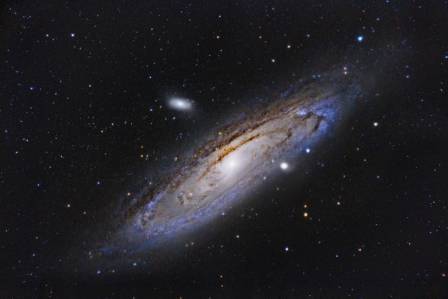
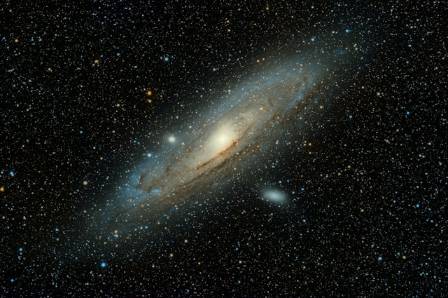
Astrophotographers around the world frequently capture stunning images of M31. Long-exposure photographs reveal bright star-forming regions, dark dust lanes, glowing spiral arms, and companion galaxies that remain invisible to the naked eye.
Despite all the detailed images available today, the most remarkable fact remains unchanged: Andromeda is an entire galaxy visible without a telescope.
Conclusion
The Andromeda Galaxy, located approximately 2.5 million light-years from Earth, is the nearest large spiral galaxy to the Milky Way and the most distant object commonly visible without optical aid. Whether viewed with the naked eye, binoculars, or a telescope, M31 offers a rare opportunity to look directly across intergalactic space and witness one of the universe’s greatest celestial neighbors.
यह भी पढ़ें

Iced Coffee in Minutes
Mason Walker
विनिर्माण क्षेत्र में रोबोटिक आर्म्स के लिए एक व्यापक मार्गदर्शिका
नंदलाल गौतम

स्ट्रॉबेरी की 3 किस्में, समझाई गई
How Elevated Trains Revolutionized City Travel
Quinn Carter
The Surprising History and Cutting Edge Future of Modern Prosthetics
Ruby Sinclair

White Ceramic Tea Sets: Why They’re Still Popular
Isolde Raven