विशेष लेख
Learn to Draw Birds
People often ask me whether my fascination with birds began with observing them in nature or with drawing them. My answer is always, “both.” For me, the two have always gone hand in hand, each enhancing the other. Sketching a bird pushes me to examine it more closely and ask questions I might never consider if I were just watching. In this way, drawing becomes a form of interaction with the bird itself.
Zoe Parker
लेखक
लेख परिचय
नीचे पूरा लेख पढ़ें।
अनुभाग
समाचार
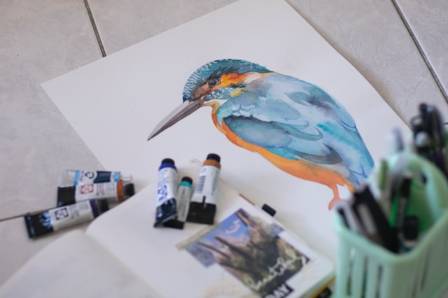
People often ask me whether my fascination with birds began with observing them in nature or with drawing them. My answer is always, “both.” For me, the two have always gone hand in hand, each enhancing the other. Sketching a bird pushes me to examine it more closely and ask questions I might never consider if I were just watching. In this way, drawing becomes a form of interaction with the bird itself.
Below are some tips I’ve gathered over the years, along with 10 video tutorials to help you start your own bird illustrations.
Begin with Large Forms
Birds are intricate creatures, and learning to draw them means simplifying what you see. Start with big, basic shapes to establish proportions and posture: an oval for the body, a circle for the head, a line to mark the angle of the bill and eye. Imagine the bird’s balance point and mark a vertical line for the feet there. Sketch these lightly at first as a framework, then gradually strengthen the lines as you refine the shape. With practice, you’ll be able to capture the essence of a bird even with just a few simple shapes on the page.
Soften the Feathers
Feathers dominate almost everything you notice when looking at a bird. Developing an understanding of how they lay and function is key. Feathers streamline the bird’s body, allowing it to move effortlessly through the air. They grow toward the tail and overlap neatly, forming a smooth, aerodynamic surface. After laying out the basic shapes, connect them with gentle, curved lines, avoiding abrupt angles. A bird only looks “fluffy” in certain areas, like the belly, under the tail, or occasionally the back of the head.
Place Feathers Thoughtfully
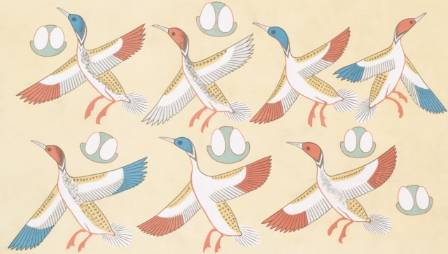
Every bird has an astonishing variety of feathers, each with a specific shape and purpose, arranged systematically. Feathers radiate outward from the base of the bill down the back and sides. Tiny feathers around the head remain mostly still, while those on the body are longer and more flexible. Flank feathers may flare to cover the lower wing edges, and wing and tail feathers are long, stiff, and move differently from the body feathers.
Feather arrangement largely determines a bird’s color patterns. Understanding the placement and movement of different feather groups is essential for accurately representing a bird.
Focus on Details
Birds are constantly moving, which makes drawing them challenging—but not impossible. Spend time observing how a bird positions its wings, the markings on its flanks, the shape and color of its beak, and other identifying features. Noticing these details will improve the accuracy and realism of your sketches.
Study Photographs
Close-up photos allow you to examine details that are hard to catch in a live bird. Working from photographs lets you focus on shapes, patterns, and textures without worrying about the bird flying away. Try doing a careful study of a photo first, replicating its details, and then test your memory and observation by quickly sketching the same bird from life or from the same image.
Still, don’t rely solely on photographs. Observing live birds is irreplaceable for truly understanding their behavior, posture, and subtle movements.
Learn Through Practice
Most early sketches may not look perfect—but don’t let that discourage you. The goal isn’t just a pretty picture; it’s about deepening your understanding of the bird. Each sketch shows what you know and highlights what you still need to learn.
Try drawing a few birds, then spend time watching them. Repeat this cycle. Enjoy the process. Your skills will improve, but more importantly, your appreciation of birds and the natural world will grow.
For guidance, check out this series of instructional videos by David Sibley, each focusing on a different North American bird. When you’re ready, share your artwork on Instagram using #SketchWithSibley and tag @audubonsociety.
यह भी पढ़ें

Fresh Mango Cream Japanese Cake Roll
Isadora Vale

Smart city
Ethan Joseph Anderson
हार्वेस्ट गोल्ड इंटीरियर टोन के साथ अपने रहने की जगह को बदलें
रणवीर बिष्ट

Iconic Classic Cars Of All Time
Mira Lennox

दुनिया की 13 सबसे प्रतीकात्मक वास्तुकलाएँ जिन्हें हर छात्र को देखना चाहिए
रिया

कप्पाडोसिया में परी चिमनी - प्रकृति की अवास्तविक मूर्तियाँ
गगन