विशेष लेख
The White Cockatoo: Nature’s Umbrella Bird
The White cockatoo (Cacatua alba), also widely known as the Umbrella cockatoo, is a medium-sized bird distinguished by its pure white plumage. This bird is endemic to the tropical rainforests of Indonesia. Its secondary name comes from its broad, backward-curving crest; when the bird raises this crest, it fans out in a shape reminiscent of an umbrella. Beyond its striking look, the species is recognized for its intelligence and complex social behaviors within its island habitat.
Brett Donovan
लेखक
लेख परिचय
नीचे पूरा लेख पढ़ें।
अनुभाग
समाचार
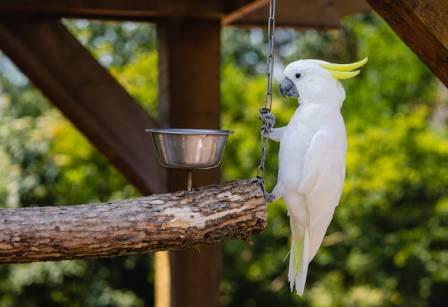
The White cockatoo (Cacatua alba), also widely known as the Umbrella cockatoo, is a medium-sized bird distinguished by its pure white plumage. This bird is endemic to the tropical rainforests of Indonesia. Its secondary name comes from its broad, backward-curving crest; when the bird raises this crest, it fans out in a shape reminiscent of an umbrella. Beyond its striking look, the species is recognized for its intelligence and complex social behaviors within its island habitat.
Physical Characteristics and Appearance
While the White cockatoo is primarily snowy white, it features subtle yellow coloration on the underside of its wing and tail feathers. This yellow tint is most visible when the bird is in flight. Adult males typically possess larger beaks and broader heads than females. One of the most reliable ways to distinguish the sexes is by their eyes: mature males have dark brown or black irises, whereas mature females often develop a reddish-brown iris.
Like other members of the parrot family, this species has zygodactyl feet, meaning two toes point forward and two point backward. This anatomical feature allows them to be highly dexterous, enabling them to hold food in one foot while standing on the other. Additionally, their feathers produce a fine, talcum-like powder used for waterproofing, which can easily rub off on surfaces or clothing.
Habitat and Geographical Distribution
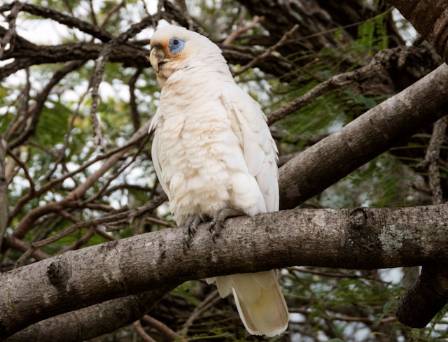
This species is native to the North and Central Moluccas in Indonesia, specifically inhabiting islands such as Halmahera, Bacan, Ternate, and Tidore. While they have been spotted on the islands of Obi and Bisa, these populations are generally believed to be descended from escaped pets.
White cockatoos favor various wooded environments, including primary tropical rainforests, mangroves, swamps, and open woodlands. They are also known to frequent agricultural areas and are most commonly found at the edges of clearings or near riverbanks. Most of their active hours are spent high within the tree canopy, where they find both food and safety.
Lifestyle and Behavioral Traits
White cockatoos are diurnal and highly social, though they typically travel in small groups or pairs rather than massive colonies. During the day, they may be found in groups of up to fifteen, but in the late afternoon, larger gatherings of up to fifty birds often form. Despite being social, they are also territorial. They have been observed using tools—such as banging a piece of wood against a tree trunk—to signal ownership of a territory to other birds.
Their communication repertoire is extensive, involving both vocalizations and physical gestures. They are capable of making loud, grating screeches to keep in touch with the flock or hissing when they feel threatened. Their crest is a primary tool for body language; a raised crest can signal excitement, curiosity, fear, or a warning to stay away, while a lowered crest generally indicates a calm and approachable state.
Dietary Habits and Nutrition
Primarily herbivorous, the diet of the White cockatoo consists largely of seeds, nuts, and tropical fruits like papaya, durian, and rambutan. As frugivores and granivores, they play a vital ecological role in seed dispersal across their native islands. Occasionally, they supplement their plant-based diet with small insects or lizards, such as crickets and skinks, to meet their nutritional needs.
Reproduction and Life Cycle
This species is monogamous, with pairs often remaining together for their entire lives. During the breeding season, which typically spans from December to March, the male performs a "strutting" display with a raised crest to attract a mate. Pairs usually nest in the hollows of tall, sturdy trees.
A female typically lays two to three eggs, and both parents share the responsibility of incubation for about 30 days. Interestingly, parents often focus their resources on the first healthy chick that hatches. Young birds begin to fly at roughly three months of age but remain dependent on their parents for several weeks after. White cockatoos reach reproductive maturity at around six years of age and can live between 30 and 40 years in the wild.
Conservation Status and Threats
The White cockatoo is currently classified as an Endangered species. Its population is in decline due to several human-related factors. The most significant threat is illegal trapping for the cage bird trade, fueled by its popularity as a pet. Additionally, the destruction of tropical forests for agriculture and logging has significantly reduced the available nesting sites and food sources for the remaining wild population. Conservation efforts are crucial to ensure that this iconic Indonesian bird continues to thrive in its natural environment.
यह भी पढ़ें

स्वीट पर्सनैलिटी वाली 10 क्यूट डॉग ब्रीड
साक्षी

दुनिया भर के 7 सबसे अच्छे फिटनेस इवेंट्स
उत्कर्ष

The Enigmatic Tale of Zakynthos' Shipwreck Beach: Greece's Crown Jewel
Gabriel Jude

हैमबर्गर के आश्चर्यजनक स्वास्थ्य लाभ
गौरव

समुद्री ढेर क्या है?
अभय
Japan’s 6 Signature Crab Varieties: Origins, Seasons, and How to Serve Them
Stella Ellis