विशेष लेख
Facts On The White Fox
The white fox, commonly known as the Arctic fox, is a remarkable animal adapted to survive in some of the coldest and most extreme regions on Earth. These foxes possess specialized traits that allow them to thrive in frigid temperatures and harsh tundra landscapes, making them uniquely suited to their icy habitats.
Hazel Clarke
लेखक
लेख परिचय
नीचे पूरा लेख पढ़ें।
अनुभाग
समाचार
The white fox, commonly known as the Arctic fox, is a remarkable animal adapted to survive in some of the coldest and most extreme regions on Earth. These foxes possess specialized traits that allow them to thrive in frigid temperatures and harsh tundra landscapes, making them uniquely suited to their icy habitats.
Classification and Features
The Arctic fox, scientifically named Vulpes lagopus, is also referred to as the polar fox or snow fox. It belongs to the kingdom Animalia and the Canidae family, placing it among other fox species like the red fox, as well as dogs, wolves, coyotes, and dingos.
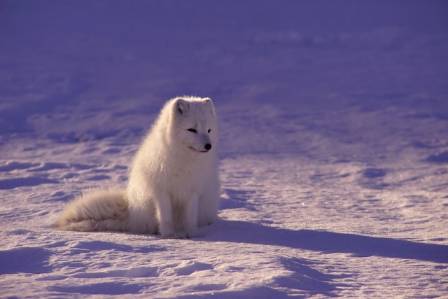
Their most iconic feature is their dense white fur, which provides camouflage against the snow, aiding in hunting prey and evading predators. In the warmer months of spring and summer, their coat shifts to a grayish-brown hue, blending with the rocks and earth of the tundra.
Arctic foxes are small, with adults weighing between 6 and 17 pounds and measuring 2–3 feet in body length, with a height of roughly 0.2–0.3 feet. Despite their small size, they are well-equipped to survive temperatures as low as –94°F. Their playful and energetic behavior often draws comparisons to young puppies or kittens. In the wild, they typically live 3–6 years, although some can reach 14 years in captivity.
Reproduction
Arctic foxes are monogamous, usually forming life-long pairs. Breeding occurs in the spring, typically in April or May. Females give birth to litters of 6 to 19 pups, which are nurtured in dens. While the female tends to the young, the male hunts to provide food for both the mother and pups.
Habitat
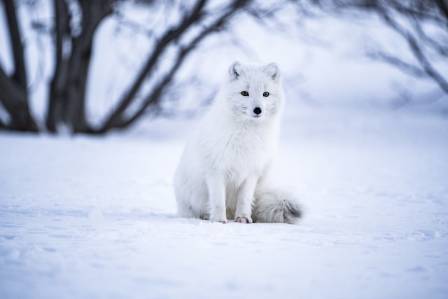
True to their name, Arctic foxes primarily inhabit the tundra of the Northern Hemisphere. Their range extends across Alaska, Canada, Greenland, Russia, Iceland, Northern Asia, and Scandinavia. Notably, they are the only terrestrial mammals native to Iceland.
While most Arctic foxes are found in icy, open tundra, some also inhabit boreal forests, especially in parts of Alaska and Canada.
Diet and Hunting
Arctic foxes are omnivorous, consuming both animal and plant matter. Their diet includes:
Lemmings, voles, and other small rodents
Arctic hares and rabbits
Seal pups
Birds and eggs
Small fish
They are also scavengers, often following polar bears at a safe distance to feed on leftover carcasses. During times of scarcity, they supplement their diet with berries and other plant material.
Hunting is highly specialized: many of their prey burrow beneath the snow for warmth. The Arctic fox uses its acute hearing to detect movements underground, then leaps and pounces to break through the snow and capture the prey.
Predators
Arctic foxes face predation from larger Arctic animals such as wolves and polar bears. Humans also pose a threat, primarily through hunting for their valuable fur.
यह भी पढ़ें

लाल गुलाब प्रेम और रोमांस का प्रतीक हैं। पेश है लाल फूलों वाले गुलाबों की हमारी पसंदीदा किस्में।
अक्षय

मनमोहक चुनाव: आपके छोटे की दुनिया के लिए बेहतरीन दीवार कला
ध्रुवेश

The Corner Towers of the Forbidden City
Sophia Bennett

3 Key Reasons for the Significance of Traffic Signs
Morgan

कॉफी के 9 अनोखे लाभ
उमेश

महासागर का हर्षित मार्गदर्शक
आइला रेनफोर्ड