विशेष लेख
The world’s different types of swan
Swans have long been admired as symbols of elegance, beauty, devotion, and purity. Their graceful movements as they glide across lakes and rivers make them one of the most recognizable groups of waterbirds. While many people are familiar with the well-known mute swans found on waterways in the UK, there are several other swan species around the globe, each with their own special features, habits, and vocalizations.
Christopher Hayes
लेखक
लेख परिचय
नीचे पूरा लेख पढ़ें।
अनुभाग
समाचार
Swans have long been admired as symbols of elegance, beauty, devotion, and purity. Their graceful movements as they glide across lakes and rivers make them one of the most recognizable groups of waterbirds. While many people are familiar with the well-known mute swans found on waterways in the UK, there are several other swan species around the globe, each with their own special features, habits, and vocalizations.
At MK Swan Rescue, the main focus is on caring for and protecting mute swans. However, learning about the other swan species helps highlight the incredible variety and adaptability found within this remarkable group of birds. From the powerful calls of North America’s trumpeter swan to Australia’s unique black swan, every species represents a fascinating part of the world’s wildlife.
Swans are large aquatic birds belonging to the genus Cygnus, which contains six living species. Another bird, the coscoroba swan (Coscoroba coscoroba), is often included in discussions of swans because of its similar appearance and behaviour, even though it belongs to a different genus. Together, these birds are sometimes referred to as the “magnificent seven” types of swans.
Mute Swan (Cygnus olor)
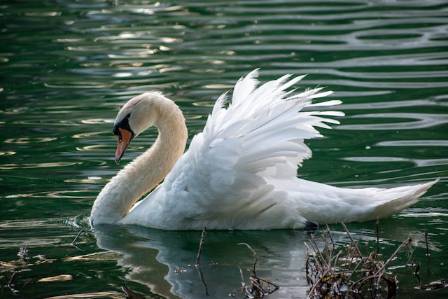
The mute swan is one of the most familiar swan species and is widely recognized by its bright orange bill with a noticeable black lump at the base.
It naturally occurs across Europe and parts of Asia, but it has also been introduced to regions such as North America and other parts of the world.
Despite its name, the mute swan is not completely silent. It can produce a variety of sounds, including whistles, hisses, and barking-like calls.
Whooper Swan (Cygnus cygnus)
The whooper swan is identified by its distinctive yellow-and-black bill pattern.
This species breeds in northern regions of Europe and Asia. During winter, it migrates southward to areas including southern Europe and eastern Asia to escape colder conditions.
Its powerful calls and large size make it one of the most impressive swans found in the Northern Hemisphere.
Tundra Swan (Cygnus columbianus)
The tundra swan is the smallest true swan species and is divided into two recognized subspecies.
Bewick’s Swan (C. c. bewickii)
Bewick’s swans breed in the Arctic tundra areas of northern Europe and Siberia. When winter arrives, they travel to western Europe and parts of Asia.
They have a yellow-and-black bill pattern that is different from the whooper swan. Their bill usually contains more yellow coloring, but the shape and pattern are less uniform.
Whistling Swan (C. c. columbianus)
The whistling swan breeds in Arctic regions of North America and spends winter months in various parts of the United States.
It is recognized by its mostly black bill, which has a small yellow marking near the base.
Trumpeter Swan (Cygnus buccinator)
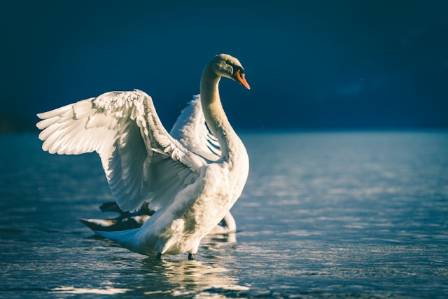
The trumpeter swan is the largest swan species native to North America.
It is famous for its deep, powerful call, which resembles the sound of a trumpet. This species has completely black bills and pure white feathers, giving it a striking appearance.
Black Swan (Cygnus atratus)
The black swan is native to Australia and is one of the most unusual-looking swan species.
Unlike most swans, which are mainly white, this species has mostly black feathers with contrasting white wing feathers visible during flight.
It also has a bright red bill, making it easy to identify.
Black-Necked Swan (Cygnus melancoryphus)
The black-necked swan is found in South America.
It has a mostly white body combined with a black neck and head. A distinctive red knob at the base of its bill adds another unique feature to its appearance.
This species inhabits wetlands and waterways across parts of southern South America.
Coscoroba Swan (Coscoroba coscoroba)
The coscoroba swan is native to southern South America and is the smallest bird commonly described as a swan.
It measures approximately 90 to 115 centimeters in length and has a wingspan of around 155 centimeters.
Unlike true swans, it belongs to its own genus, Coscoroba. Its white feathers, black tips on the outer wing feathers, red bill, and red legs give it a swan-like appearance.
Although genetically different from true swans, the coscoroba swan shares many physical and behavioural characteristics with them. Scientists have also identified a relationship between this species and the Cape Barren goose (Cereopsis novaehollandiae).
Because of these similarities, the coscoroba swan is often included alongside the six true swan species as part of the “magnificent seven.”
The Unique Charm and Importance of Swans
Although swan species vary greatly in their size, colors, habitats, and calls, they all share an elegance that continues to inspire people around the world.
From the frozen Arctic landscapes where tundra and whooper swans thrive to the wetlands of South America where black-necked and coscoroba swans live, each species brings its own special character to the environment it inhabits.
At MK Swan Rescue, the mission remains focused on protecting mute swans around Milton Keynes and ensuring these beautiful birds receive the care and support they need.
By supporting conservation efforts, volunteering, or making a donation, people can help protect swans and preserve the natural beauty these remarkable birds bring to waterways around the world.