विशेष लेख
Physical AI: The Confluence of Innovation and Market Opportunity
The prevailing discourse surrounding Artificial Intelligence has primarily focused on its cognitive capabilities, emphasizing algorithmic development, large-scale models, and semiconductor advancements. However, a significant transformation is currently taking place as AI-driven humanoid robotics transition from experimental laboratories into the functional economy. This evolution does not signify a simple replacement of human labor but rather an era of workforce augmentation and a burgeoning landscape for strategic investment.
Iris Juliette Marlowe
लेखक
लेख परिचय
नीचे पूरा लेख पढ़ें।
अनुभाग
समाचार
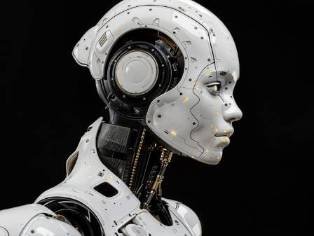
The prevailing discourse surrounding Artificial Intelligence has primarily focused on its cognitive capabilities, emphasizing algorithmic development, large-scale models, and semiconductor advancements. However, a significant transformation is currently taking place as AI-driven humanoid robotics transition from experimental laboratories into the functional economy. This evolution does not signify a simple replacement of human labor but rather an era of workforce augmentation and a burgeoning landscape for strategic investment.
The market for humanoid robotics is currently at a critical juncture. Valued at approximately $2 billion to $3 billion today, the sector is forecasted to reach $40 billion by 2035 in standard growth models, with high-acceleration scenarios suggesting a potential surge to $200 billion. Capital allocation is already reflecting this shift; venture funding for robotics reached $8.8 billion in the second quarter of 2025, representing a fifteenfold increase since 2017. Unlike the initial software-centric wave of AI, this secondary phase places equal importance on hardware, particularly for companies within the physical supply chain that produce actuators and high-precision mechanical components.
The Structural Pillars of the Humanoid Supply Chain
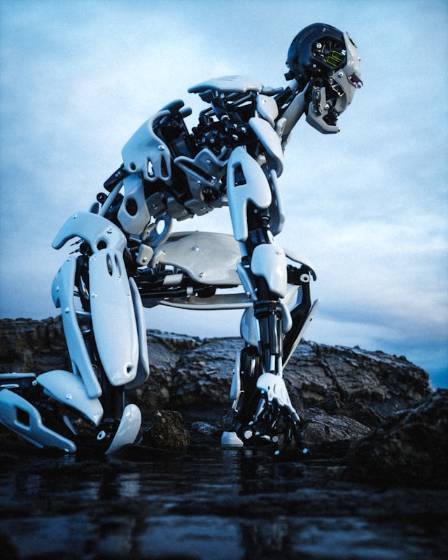
The rapid acceleration of the humanoid sector is built upon three foundational technologies: cognitive processing, mechanical systems, and energy storage. Significant progress in these "three Bs"—Brains, Brawn, and Batteries—has moved these machines toward commercial viability.
Advancements in "Brains" involve breakthroughs in vision and motion systems, allowing machines to navigate and reason within unpredictable environments. "Brawn" refers to the mechanical hardware that replicates human movement, currently accounting for half of a humanoid's production cost. Scaling these components is essential for economic feasibility. Finally, "Batteries" are seeing critical improvements in energy density to meet the high power demands of bipedal motion. These collective innovations have driven unit production costs down from $3 million to approximately $100,000 over the last decade, making commercial deployment a realistic prospect.
Manufacturing Specialization and the Regional Edge
While AI development is a global endeavor, specific regions are emerging as leaders in different segments of the humanoid ecosystem. The United States and Japan remain centers for core innovation, and China currently leads in high-volume production. However, Europe is establishing a dominant position in "Brawn"—the high-precision engineering required for movement.
A humanoid robot functions essentially as a miniaturized, highly complex vehicle, requiring a multi-tiered supply chain of precision parts. Europe’s deep automotive heritage provides a significant advantage here, with the region controlling 34% of the global supply chain for precision components. Germany alone supplies roughly one-third of the world’s actuators. This capacity to repurpose automotive expertise for robotic manufacturing offers a specialized competitive edge for industrial partners and investors.
Battery Evolution and Resource Dependencies
Energy storage is a vital component of the physical AI chain, currently representing about 15% of total production costs. While humans remain more energy-efficient for most physical tasks, lithium-ion battery prices have decreased eightfold over the last ten years, making integrated power systems more viable.
The growth of the humanoid market will inevitably drive demand for critical minerals, including copper, lithium, aluminum, nickel, and cobalt. Because the supply of these materials—as well as the rare earths required for magnetic actuators—is currently concentrated in specific regions, there is a significant opening for established mining operations outside these areas to fill strategic gaps in the global supply chain.
Addressing Global Labor Disparities Through Automation
Macroeconomic pressures stemming from demographic shifts are fueling the demand for bipedal robots capable of operating in environments designed for humans. Three primary factors are driving this need: an aging global population, the concentration of talent in urban centers (which leaves agriculture and manufacturing undersupplied), and a decreasing willingness among the workforce to perform hazardous or repetitive manual labor.
Humanoid robotics are also finding applications in the defense sector, where innovation in autonomous systems often has a spillover effect into civilian technology. With global defense spending projected to rise significantly by 2035, the demand for advanced robotic components will likely follow. These machines are poised to fill acute gaps in sectors like healthcare, where the demand for nursing personnel is outstripping supply, and in manufacturing, where the workforce is aging faster than the general population.
Shifts in Corporate Cost Structures and the Future of Work
The integration of humanoids is expected to fundamentally redefine business cost structures. Organizations with high operational expenses related to labor may shift toward higher capital expenditure on robotics. This transition from variable labor costs, which are sensitive to inflation, to stable, depreciable assets can strengthen margins and enhance long-term valuations.
Ultimately, the future of work is a collaborative model. By automating physically demanding or routine tasks, humanoid robots allow human workers to focus on oversight and higher-value cognitive activities. This partnership addresses demographic challenges while maintaining service quality and controlling long-term costs.
यह भी पढ़ें

टोक्यो टावर
मधु

पांच बेहतरीन स्पोर्ट्स कारें जिन्हें आप अभी खरीद सकते हैं
द्रौपदी

बेहतरीन फिश एंड चिप्स की पहचान कैसे करें: एक विशेषज्ञ गाइड
वैष्णवी प्रसाद

रेन
राहुल

दुनिया की सबसे पतली स्काईस्क्रेपर: स्टाइनवे टावर
सुष्मा

घास के मैदानों के बगीचे आजकल तेज़ी से लोकप्रिय हो रहे हैं—इसे कैसे उगाएँ, जानिए
अनिता