विशेष लेख
Great Salt Lake
Great Salt Lake is the largest saltwater lake in the Western Hemisphere and ranks as the eighth-largest saline lake on Earth. The lake’s ecosystem represents an exceptional example of the complex connections between humans, the environment, water resources, food systems, and survival.
Everett Dawson
लेखक
लेख परिचय
नीचे पूरा लेख पढ़ें।
अनुभाग
समाचार
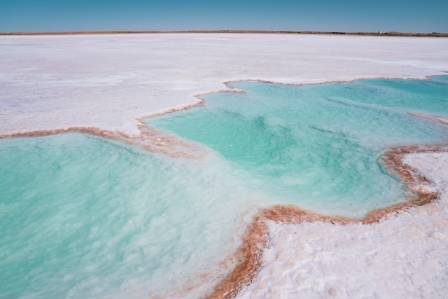
Great Salt Lake is the largest saltwater lake in the Western Hemisphere and ranks as the eighth-largest saline lake on Earth. The lake’s ecosystem represents an exceptional example of the complex connections between humans, the environment, water resources, food systems, and survival.
Its diverse habitats, including open water areas, isolated islands, wetlands, and extensive shorelines, support a wide variety of life. The region contains the highest concentration of wetlands in Utah, providing essential environments for plants, brine shrimp, reptiles, amphibians, mammals, shorebirds, and waterfowl.
The lake is also a vital stop along the Pacific Flyway, an important migratory route connecting North and South America. Each year, up to 12 million birds representing 339 species depend on Great Salt Lake for resting, feeding, and breeding during journeys that can exceed thousands of miles. As many other inland lakes continue to decline, the importance of Great Salt Lake as a wildlife refuge continues to grow.
Preservation and Protection Efforts
The Utah Department of Natural Resources is dedicated to conserving and safeguarding Great Salt Lake. The Division of Water Resources supports these efforts through several programs, including the development of the Great Salt Lake Basin Integrated Plan, scientific research and modeling of the lake and its connected river systems, implementation of water-saving initiatives, and management of Utah’s cloud seeding program.
These projects help increase public understanding of the lake’s ecological importance, explain the responsibilities of different agencies, and highlight ongoing actions aimed at protecting this unique natural resource.
Changes in Lake Levels
Because Great Salt Lake is extremely shallow, with an average depth of about 14 feet and a maximum depth of approximately 35 feet, its water level can change dramatically depending on weather conditions. During dry periods, the lake can shrink significantly, while wet years can cause rapid increases in water volume.
Normally, spring snowmelt causes the lake level to rise by around 2 feet. However, exceptional snowfall in 2023 resulted in an increase of approximately 5.5 feet. In contrast, during 2022 and 2021, limited snowpack caused the lake to rise by only about 1 foot.
The lake’s shallow and warm waters also contribute to frequent lake-effect snowstorms in the Wasatch Mountains. These storms provide roughly 5–10% of the mountain snowpack and support winter recreation and tourism.
When water levels decline, larger areas of exposed lakebed become vulnerable to wind erosion. Dust from these dry surfaces can contain heavy metals and chemical pollutants, reducing air quality and creating environmental concerns.
At its historical average elevation of 4,200 feet, Great Salt Lake measured about 75 miles in length and 35 miles in width, covering nearly 1,700 square miles.
Record Low Water Levels
Great Salt Lake reached a historic low point in November 2022, when the average daily water elevation fell to 4,188.5 feet at the South Arm Causeway measurement station.
Before this, the previous record low occurred on October 18, 2021, when the lake level dropped to 4,190.2 feet. Earlier historical records show that the previous lowest level was recorded in October 1963, when the elevation reached 4,191.35 feet, commonly rounded to 4,191.4 feet according to the reporting standards of that period. At that time, the lake covered approximately 950 square miles.
The lake later reached a historic high in 1986, when its surface area expanded to about 3,300 square miles and the elevation reached 4,211.65 feet. This measurement included areas temporarily flooded when pumping systems were operating and parts of the western desert were inundated.
The U.S. Geological Survey has maintained records of Great Salt Lake levels since 1847, beginning when early pioneers first established settlements in Utah.
Geography and Lake Infrastructure
The unique geography of Great Salt Lake, combined with human-built infrastructure, has created several distinct aquatic environments. Salt concentrations vary greatly across the lake, ranging from nearly 28% in the extremely saline North Arm to between 6% and 27% in the South Arm.
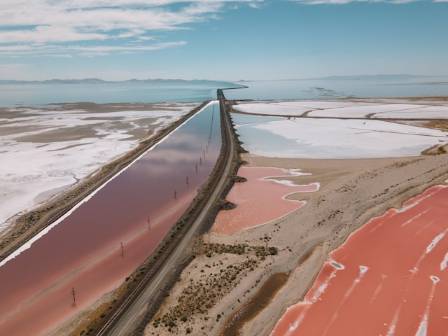
A major influence on the lake’s modern structure is the Lucin Cutoff railway, which crosses the lake near the southern end of the Promontory Peninsula. The largely solid railroad causeway divides Great Salt Lake into three main sections: the northeast arm, northwest arm, and southern arm.
Because the causeway limits the natural circulation of water, the northwest arm receives little mixing with the rest of the lake. As a result, it has become much saltier than other areas.
The different salinity conditions affect the types of algae that grow in each section of the lake. This variation creates a noticeable difference in water color between the two sides of the causeway.
Economic Importance
Several major rivers, including the Jordan River, Weber River, and Bear River, flow into Great Salt Lake and deliver millions of tons of dissolved minerals and salts every year.
The lake contributes approximately $1.9 billion annually to the economy and supports more than 7,700 jobs. Industries operating around the lake play an important role in supplying global markets with resources such as magnesium, sulfate of potash, and brine shrimp.
Mining operations remove nearly 2 million tons of minerals from the lake each year. These materials are extracted through large evaporation ponds, where water is removed naturally through evaporation.
More than 85,000 acres of diked evaporation ponds exist within Great Salt Lake, covering an area roughly twice the size of San Francisco. These industrial areas demonstrate the lake’s importance not only as an ecological resource but also as a major economic asset.
यह भी पढ़ें

झानकियाओ पियर – किंगदाओ ओल्ड टाउन
दिव्या

प्राचीन रेत की फुसफुसाहट: मिस्र के कालातीत पिरामिडों की यात्रा
विवेक

8 Cool Off-Roading Features for Trucks
Viona

The Benefits of a 1 Seater Sofa
Sophia Mitchell

Exploring Seabirds: Masters of the Ocean Realm
Thalia Rose

सिल्क रोड के किनारे सबसे खूबसूरत झीलें और घास के मैदान
तनिष्क