विशेष लेख
5 Streaked Sparrows Made Easy
Sparrows are found in a surprising range of environments: some hide in the tall grasses of prairies, others sing from branches in dry shrublands, and a few are familiar visitors in suburban backyards. Yet, no matter their habitat, telling one sparrow from another can feel like a daunting challenge.
Ezra Quinn
लेखक
लेख परिचय
नीचे पूरा लेख पढ़ें।
अनुभाग
समाचार
Sparrows are found in a surprising range of environments: some hide in the tall grasses of prairies, others sing from branches in dry shrublands, and a few are familiar visitors in suburban backyards. Yet, no matter their habitat, telling one sparrow from another can feel like a daunting challenge.
“Identifying sparrows is tough! Successfully naming one is something to celebrate,” says Kevin McGowan, author and instructor of the Cornell Lab of Ornithology’s online Sparrow Identification course. “There’s no single shortcut for spotting sparrows. You need to use your full birding toolkit and study each species individually.”
There are 43 commonly observed New World sparrow species across the U.S. and Canada. This family, Passerellidae, also includes towhees, juncos, and the Lark Bunting. Many birds called “sparrows” are small and brown, often with streaked backs and the classic conical bills for cracking seeds. Bold colors are uncommon, which can make these birds seem perplexing to identify.
Sparrows display subtle but elegant plumages, distinctive behaviors, and individual songs. Figuring out their identity is a puzzle that requires looking at multiple clues: size and shape, color patterns, behavior, habitat, field marks, geographic range, and calls.
Here are expert tips from Dr. McGowan for distinguishing five of the most widespread—but sometimes confusing—sparrows.
Song Sparrow
The Song Sparrow lives up to its name. Its tune often begins with several crisp notes, followed by trills, buzzes, or complex sequences, and is frequently heard in spring and early summer. Because it is common in backyards, this species is a great starting point for learning key field marks, which are useful for comparison with other sparrows.
Song Sparrows are medium-sized with long tails. Their chest streaks converge in a central spot, giving the appearance of a painted patch. Triangular brown stripes flank the throat, a pale eyebrow line appears above the eye, and a thin dark line runs behind the eye.
Song Sparrows show considerable variation across their range, making careful observation essential. More details can be found in the All About Birds species guide.
Fox Sparrow
Fox Sparrows breed farther north than Song Sparrows, in scrubby boreal forests or mountainous shrublands. Most birders encounter them during migration or winter, where they might appear beneath feeders.
These sparrows employ a “double-scratch” foraging method, hopping quickly forward and backward to uncover seeds in leaf litter. Chest streaks are thicker and blurrier than the Song Sparrow’s, giving a softer, less defined look. Their song consists of clear musical notes and sliding whistles.
There are five distinct forms of Fox Sparrows in North America. Further information is available in the All About Birds guide.
Savannah Sparrow
Found across grasslands throughout much of North America, the Savannah Sparrow is roughly the size of a Song Sparrow but with a slightly shorter, notched tail. Its face often displays yellow markings near the eyes, though the intensity varies.
When flushed, it usually flies to a perch and faces the observer, a behavior that helps differentiate it from the more secretive LeConte’s and Grasshopper Sparrows. Its song is thin and insect-like, combining short notes with a high-pitched, buzzy segment.
Learn more about Savannah Sparrows in the All About Birds species guide.
Lincoln’s Sparrow
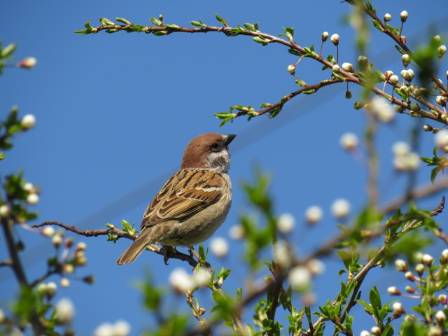
Lincoln’s Sparrows are delicately marked, with crisp, finely detailed streaks. A buffy wash on the chest and throat sides sets them apart from other streaked sparrows.
They breed in boggy areas of boreal forests and mountains but use varied habitats during migration and winter. Lincoln’s Sparrows are often shy and stay hidden in dense vegetation. Their song is highly musical, consisting of cascading trills, gurgles, and buzzes.
For additional information, see the All About Birds species guide.
Vesper Sparrow
The Vesper Sparrow inhabits grasslands and fields across much of the U.S. and Canada. As its name implies, it often sings at dusk, although it can also sing at dawn. Its song begins with two clear downward notes, followed by musical trills and whistles.
A fully white eye-ring distinguishes it from other streaked-breasted sparrows. In flight, note its long tail with white outer feathers. In agricultural areas, Vesper Sparrows may be spotted among growing corn, one of the few sparrows to use summer crops rather than only postharvest fields.
Sparrows can be a tricky group, but learning to distinguish them opens a fascinating window into their subtle behaviors, songs, and habitats. From backyard Song Sparrows to distant Vespers in open fields, these birds provide endless opportunities for observation and discovery.